

Non Toxic Bug Repellent: Safe Solutions for Your Outdoor Space
When mosquitoes threaten to ruin another outdoor gathering, reaching for harsh chemical sprays feels like the only option. Yet more families are questioning whether coating everyone in synthetic repellents is the right trade-off for an evening on the patio. The good news is that non toxic bug repellent technology has advanced far beyond ineffective citronella candles, offering real protection without compromising safety or comfort. Understanding the science behind natural repellent methods and how they differ from conventional options helps you choose the right approach for your outdoor sanctuary.
Understanding What Makes Bug Repellent Non Toxic
The term "non toxic" in pest control context typically refers to products formulated without synthetic chemicals like DEET, picaridin, or permethrin. According to the EPA's guidance on minimum risk pesticides, certain plant-based ingredients are classified as posing minimal risk to human health and the environment when used properly.
Key characteristics of truly non toxic formulations include:
- Biodegradable active ingredients
- No synthetic neurotoxins or hormone disruptors
- Safe for use around children and pets when applied correctly
- Minimal environmental persistence
The EPA's overview of insect repellents explains that many natural products fall under the 25(b) exemption category, meaning they contain only ingredients deemed safe enough to bypass conventional pesticide registration. This regulatory distinction matters because it reflects ingredient safety profiles backed by scientific review.
The Science Behind Natural Repellent Mechanisms
Natural repellent ingredients work differently than synthetic chemicals. DEET confuses mosquito receptors that detect carbon dioxide and body odor, essentially scrambling their tracking ability when applied directly to skin. Natural alternatives operate through complementary mechanisms.
Plant-based repellents typically function through:
- Scent masking that hides human odors mosquitoes hunt
- Volatile compounds that irritate mosquito sensory organs
- Spatial vapor barriers that repel insects from treated areas
- Multi-ingredient synergies where combinations outperform single oils
Research published in Scientific Reports demonstrates strong repellent activity from natural compounds like nepetalactone from catnip. The study showed comparable efficacy to synthetic options in controlled conditions, validating that plant-derived chemistry can indeed interrupt mosquito host-seeking behavior.

Essential Oil Ingredients That Actually Work
Not all natural ingredients deliver meaningful protection. Consumer Reports testing reveals significant performance variation among botanical repellents. The most effective non toxic bug repellent formulas combine multiple proven essential oils rather than relying on single ingredients.
| Essential Oil | Primary Mechanism | Typical Duration | Key Research Finding |
|---|---|---|---|
| Geraniol | Scent masking, irritant | 2-4 hours | Effective against multiple mosquito species |
| Citronella | Spatial vapor, masking | 1-2 hours | Works best in enclosed spaces |
| Peppermint | Sensory irritation | 2-3 hours | Strong initial knockdown effect |
| Eugenol (clove) | Neurotoxic to insects | 3-4 hours | Longer residual than most botanicals |
| Cornmint | Cooling irritant | 2-3 hours | Synergizes with other mints |
| Rosemary | Multi-pathway disruption | 2-4 hours | Broad-spectrum activity |
Geraniol stands out as particularly effective. Studies show it disrupts mosquito olfactory receptors while masking the human scent signatures that mosquitoes track from 30 feet away. When formulated at proper concentrations, geraniol-based products deliver protection comparable to low-concentration DEET formulas.
The challenge with essential oils lies in their volatility. They evaporate quickly, which explains why many natural sprays require reapplication every 30 to 60 minutes. Advanced delivery systems that control release rates extend protection windows significantly.
Formulation Matters More Than Ingredients Alone
A recent Frontiers review examining laboratory methods for evaluating mosquito repellents highlights why identical ingredients perform differently across products. Concentration, carrier matrices, and stabilizers dramatically impact efficacy and duration.
Modern non toxic bug repellent technology uses several approaches to improve performance:
- Microencapsulation that releases active ingredients gradually
- Solid substrate carriers that control evaporation rates
- Synergistic blends where combined oils outperform individual components
- Spatial application methods that protect areas rather than individuals
The shift from wearable sprays to space-protecting formulations represents a fundamental rethinking of natural repellent strategy. Rather than coating skin with volatile oils that dissipate quickly, newer approaches create protective zones through ground-level scent masking.
Comparing Application Methods and Their Trade-offs
Traditional bug repellent falls into two categories: topical products applied to skin or clothing, and spatial repellents that protect areas. Each approach suits different situations, but non toxic options often excel in spatial applications.
Wearable Sprays and Lotions
Conventional topical approach:
- Applied directly to exposed skin
- Protects only the individual wearing it
- Requires reapplication every 1-4 hours
- Creates sticky, greasy feel many find unpleasant
- Difficult to ensure even coverage
- Cannot realistically ask party guests to spray down
Even natural topical formulas share these drawbacks. The delivery mechanism inherently requires skin contact, repeated application, and individual compliance. For hosts managing outdoor gatherings, this model simply does not scale.
Spatial Protection Systems
Ground and area repellent methods:
- Protect the entire gathering space
- No skin contact required
- Longer protection windows per application
- Guest-friendly with no participation needed
- Work continuously without reapplication during events
- Often more aesthetically acceptable for designed outdoor spaces
Penn State Extension's guidance on using repellents safely notes that spatial repellents reduce overall chemical exposure because active ingredients remain in the environment rather than on skin. For families concerned about cumulative chemical load, this distinction matters significantly.
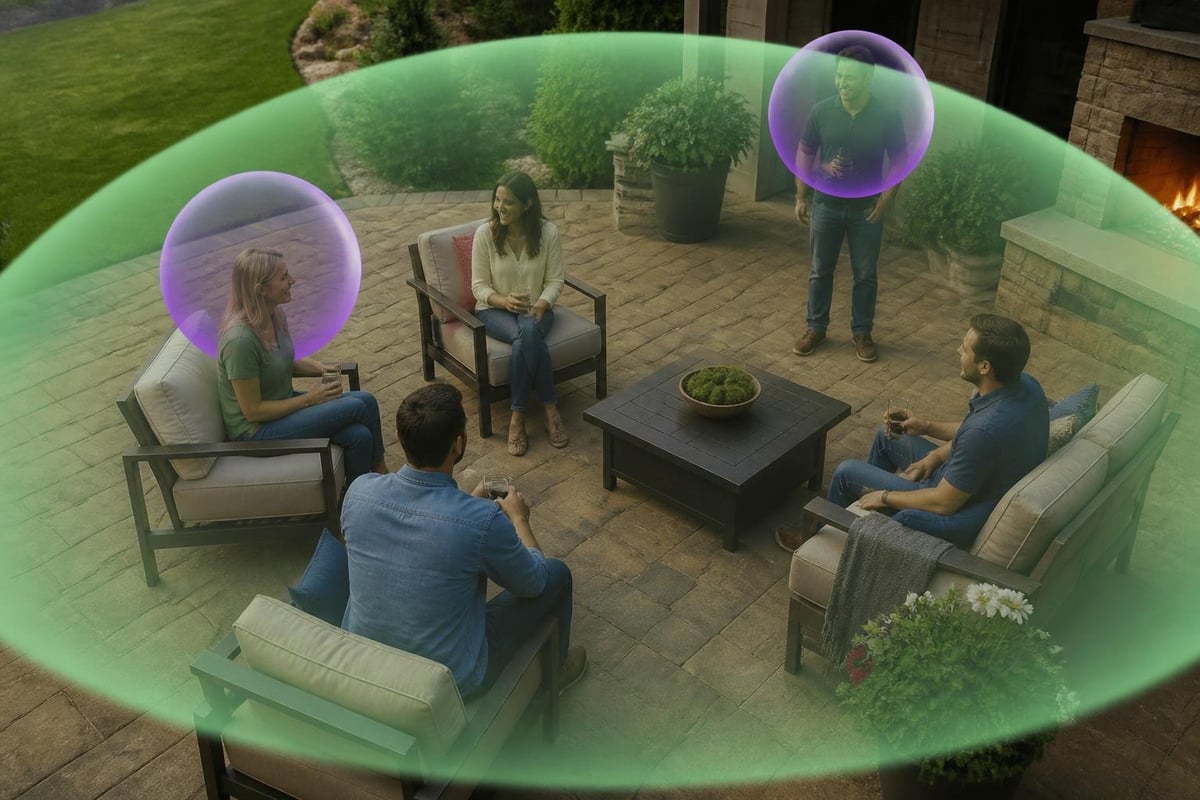
Biodegradable granules infused with essential oil blends represent the latest evolution in spatial protection. These formulations release volatile compounds gradually at ground level, where mosquitoes hunt for human scent signatures. By masking odors in the lower air column, they interrupt the hunting sequence before mosquitoes reach biting height.
For homeowners who have invested in outdoor living spaces, spatial solutions align better with how the space functions. Nothing disrupts the aesthetic of a carefully set table. No one feels sticky or smells like chemical repellent. The protection simply exists as part of the environment.
Safety Considerations for Families and Pets
One primary driver behind choosing non toxic bug repellent is concern for vulnerable household members. Young children, pregnant women, individuals with chemical sensitivities, and pets all benefit from reduced synthetic chemical exposure.
Critical safety factors to verify:
- Ingredient disclosure and transparency
- Third-party testing documentation
- Clear usage instructions for households with pets
- Age recommendations for children
- Pregnancy and nursing safety data
The NCBI peer-reviewed review of chemical and plant-based insect repellents examines safety profiles across repellent categories. While DEET shows an excellent safety record when used as directed, some individuals prefer avoiding it entirely. Natural alternatives provide that option without sacrificing all protection.
Pet-Friendly Formulations
Dogs and cats process chemicals differently than humans. Essential oils safe for people may pose risks to pets if ingested or absorbed in high concentrations. However, spatial repellents applied to ground surfaces rather than fur minimize direct contact.
When choosing pet-safe mosquito repellent, look for:
- Products specifically labeled pet-friendly
- Application methods that avoid direct animal contact
- Ingredients tested for pet safety
- Clear instructions about keeping pets away during application
- Ground-level formats rather than airborne mists
Families with outdoor pets often struggle finding effective repellents that do not require keeping animals inside during treatment. Ground-applied biodegradable beads offer a solution, they can be used in spaces pets frequent without the risks associated with sprays or treated surfaces pets might lick.
Environmental Impact and Sustainability
Beyond personal health, many households choosing non toxic bug repellent prioritize ecological responsibility. Synthetic pesticides persist in soil and water, accumulating through food chains. Natural alternatives typically break down faster with less environmental legacy.
Environmental advantages of plant-based repellents include:
- Rapid biodegradation in soil and water
- Lower aquatic toxicity
- Reduced impact on beneficial insects when properly formulated
- Renewable source materials
- Minimal bioaccumulation potential
The WHO publications on vector control and spatial repellents discuss environmental considerations alongside public health efficacy. Ideal repellent technologies balance human protection with minimal ecological disruption, a goal more achievable with natural formulations.
Corn-based carriers and plant-derived active ingredients represent closed-loop sustainability. The materials return to soil after use, completing biological cycles without introducing persistent synthetic molecules. For environmentally conscious homeowners, this alignment between personal values and practical function matters deeply.
Comparing Long-Term Cost and Value
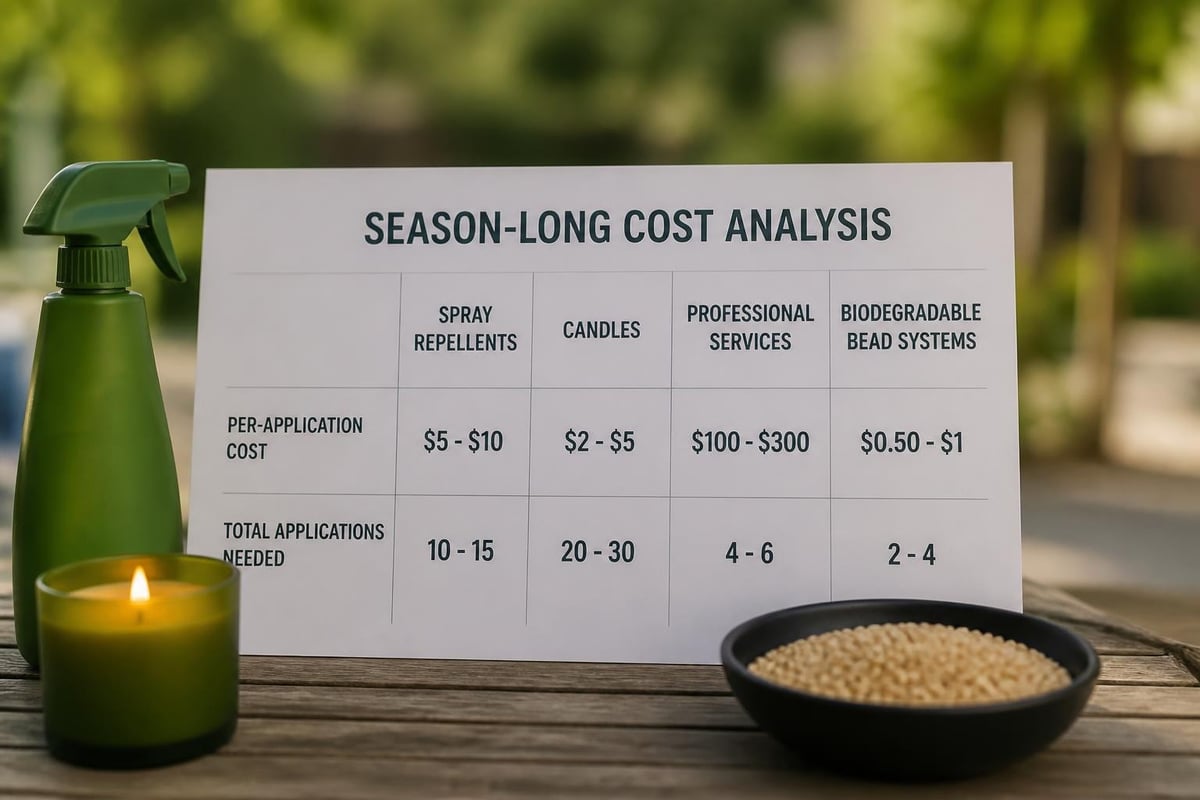
Initial price comparisons often favor conventional repellents, but total cost-of-ownership calculations tell a different story. Comparing costs between natural mosquito repellents and professional services reveals unexpected economics.
| Solution Type | Upfront Cost | Applications/Season | Cost per Use | Hidden Costs |
|---|---|---|---|---|
| DEET spray | $8-15 | 20-30 | $0.40-0.75 | Skin irritation, laundry stains |
| Citronella candles | $12-25 | 15-20 | $0.60-1.67 | Limited coverage, fire risk |
| Professional spray | $75-150 | 6-8 | $9.38-25.00 | Chemical exposure, scheduling |
| Natural beads | $25-40 | 8-12 | $2.08-5.00 | None significant |
Spatial non toxic bug repellent systems deliver multi-day protection per application, reducing the cost-per-protected-hour significantly. When hosting regular gatherings throughout mosquito season, this efficiency compounds.
Realistic Expectations and Performance Optimization
No repellent technology delivers 100% elimination under all conditions. Setting realistic expectations prevents disappointment and helps optimize whatever system you choose.
Factors affecting all repellent performance:
- Mosquito pressure and species present
- Wind speed and direction
- Temperature and humidity
- Application coverage and concentration
- Time since application
- Competing attractants (food odors, lights)
Understanding why mosquitoes target us helps contextualize repellent limitations. These insects evolved over millions of years to find blood meals. Repellents interrupt but do not completely eliminate their ability to locate hosts.
Maximizing Natural Repellent Effectiveness
Strategic application dramatically improves outcomes with non toxic bug repellent:
- Apply before mosquitoes become active (usually before dusk)
- Create continuous barriers rather than isolated treatment spots
- Cover high-traffic zones where people congregate
- Combine with habitat modification to reduce mosquito breeding
- Reapply based on actual protection decline, not arbitrary schedules
Ground-level scent masking works best when mosquitoes encounter the treated zone before detecting human odors. This means treating the perimeter and approaches to gathering areas, not just the immediate seating zone. Think about how mosquitoes move through your yard based on typical wind patterns and approach vectors.
For patios and decks, the natural mosquito repellent for outdoor spaces approach involves treating edges, entry points, and the zone 3-5 feet around seating areas. Mosquitoes hunt low, following scent plumes at ground level before ascending to bite, so intercepting them early in that sequence yields better results.
Real-World Applications and Use Cases
Different outdoor scenarios demand adapted approaches. The non toxic bug repellent strategy that works for a backyard dinner party may not suit a camping trip or sports event.
Patio and Deck Entertaining
Hosting challenges:
- Multiple guests arriving at different times
- Food and drink creating competing odors
- Aesthetic considerations for designed spaces
- Extended events (3-5 hours)
- Unwillingness to ask guests to apply repellent
Solutions combining biodegradable beads infused with geraniol, citronella, peppermint, eugenol, cornmint, and rosemary excel here. Pour granules around the patio perimeter and beneath tables before guests arrive. The scent-masking effect protects the entire space without visible flames, smoke, or equipment cluttering the aesthetic. Peak protection during days one and two aligns perfectly with weekend entertaining patterns.
Camping and RV Living
Mobile outdoor living requires portable protection. The natural mosquito repellent for camping approach prioritizes compact formats and easy transport. Small mesh bags filled with repellent beads clip to tent zippers, camp chairs, or RV awnings, creating protected zones without requiring electrical hookups or open flames that many campgrounds restrict.
Youth Sports and Outdoor Events
Parents watching games face unique constraints. Reapplying spray to active children proves nearly impossible mid-game, yet mosquitoes thrive near sports fields with evening irrigation and standing water. Pouring granules along bleacher rows and sideline team areas protects spectators and bench players without sticky applications that interfere with athletic performance. The natural mosquito repellent for sports settings needs to be guest-friendly since you cannot control other families' preferences.
Making the Switch from Conventional Products
Transitioning to non toxic bug repellent often requires adjusting expectations shaped by years of DEET use. The mechanism differs, the application differs, and the experience differs. Understanding these distinctions prevents frustration.
What stays the same:
- Need for consistent application
- Performance variations based on conditions
- Requirement to follow label instructions
- Importance of starting before mosquito activity peaks
What changes:
- Protection extends to spaces, not individuals
- No skin contact or sticky residue
- Longer intervals between applications
- More aesthetically neutral in outdoor settings
- Better alignment with entertaining workflows
Many families discover that spatial protection better matches how they actually use outdoor spaces. Rather than convincing everyone to spray themselves, the host simply prepares the space. This shifts mosquito management from individual compliance to environmental control, a model that scales much better for gatherings.
Those making the switch often appreciate unexpected benefits. Clothes stay unstained. Hands don't smell like chemicals after application. Children can play freely without parents worrying about rubbing eyes after touching treated skin. Pets roam without restrictions.
The best DEET-free solutions leverage these operational differences rather than trying to mimic spray behavior. By understanding what alternatives exist, you choose based on how you actually live outdoors, not marketing claims.
Regional Considerations and Mosquito Species
Mosquito pressure varies dramatically by geography and season. Coastal regions, lakefront properties, and humid climates present more intense challenges than arid areas. The non toxic bug repellent approach that works in Kansas may need adjustment for Florida or Houston.
High-pressure regions require:
- More frequent applications
- Higher concentrations of active ingredients
- Broader coverage areas
- Combination strategies
- Realistic expectations about breakthrough bites
In Florida, where mosquito season runs nearly year-round and multiple aggressive species hunt simultaneously, even excellent repellents face tough conditions. The best natural mosquito repellent for Florida needs staying power and broad-spectrum activity against species from Aedes aegypti to Culex quinquefasciatus.
Houston's mosquito challenges stem from humidity, frequent rain, and expansive flood-prone areas that create ideal breeding habitat. Natural repellents work but require diligent application and often supplemental habitat management.
Conversely, Kansas's seasonal mosquito activity concentrates in late spring and summer, allowing more targeted protection periods. Drier conditions reduce overall pressure compared to Gulf states.
Understanding your local mosquito ecology helps set appropriate expectations and application schedules. No single formula works optimally everywhere, but the principles of scent masking and spatial protection scale across geographies with proper adjustment.
Integration with Broader Mosquito Management
The most effective strategies layer multiple approaches rather than relying on repellent alone. Comprehensive mosquito management combines habitat modification, exclusion, and repellent use.
Complete protection strategy includes:
- Eliminating standing water where mosquitoes breed
- Managing vegetation that provides mosquito resting sites
- Using screens on windows and doors
- Timing outdoor activities to avoid peak mosquito hours
- Applying repellent to create protected zones
This integrated approach, detailed in research on mosquito control strategies, reduces reliance on any single tactic. Even the best non toxic bug repellent performs better when mosquito populations remain managed through source reduction.
Simple habitat modifications deliver disproportionate results:
- Empty flower pot saucers weekly
- Clean gutters to prevent water accumulation
- Fix leaky outdoor faucets
- Store containers upside down
- Maintain pool and fountain circulation
These actions reduce the local mosquito population, making repellent work easier. Rather than fighting overwhelming numbers, you maintain comfortable conditions against baseline pressure.
For comprehensive guidance on protecting outdoor spaces, the Mosquito Almanac offers seasonal strategies and science-backed approaches to creating comfortable outdoor environments naturally.
Choosing non toxic bug repellent represents more than avoiding specific chemicals - it reflects a broader preference for solutions that align with how families actually live outdoors. When you want to protect your patio without asking every guest to spray down, when pets share the space, when aesthetics matter as much as function, spatial scent-masking systems deliver the control you need without compromise. Mosquito Beads offers biodegradable, DEET-free protection you simply pour on the ground, creating a naturally protected outdoor sanctuary where mosquitoes drift past instead of landing. Pour where you gather, protect your space, and reclaim your outdoor room without sticky sprays or visible clutter.