

Vanilla for Mosquitoes: Does It Really Repel Them?
If you've spent any time searching for natural mosquito solutions, you've likely encountered vanilla in some form. The idea of vanilla for mosquitoes sounds appealing: a sweet-smelling, non-toxic option from your kitchen cupboard that might keep biting pests away from your patio. Many online sources promote vanilla extract, vanilla beans, or vanillin as simple DIY repellents. But does the science support these claims, or is vanilla just another mosquito myth? This article examines what research actually shows about vanilla compounds, how they interact with other repellents, and what practical options deliver real protection for families who want to enjoy their outdoor spaces without chemical sprays.
Understanding Vanilla Compounds and Mosquito Behavior
Vanilla itself isn't a single substance. When people talk about vanilla for mosquitoes, they're usually referring to one of three things: pure vanilla extract (alcohol-based), imitation vanilla flavoring, or vanillin (the primary aromatic compound). Mosquitoes hunt primarily by tracking human scent, particularly carbon dioxide, lactic acid, and body odor compounds that rise from skin and ground level.
Vanillin, the molecule responsible for vanilla's signature smell, doesn't directly repel mosquitoes the way DEET or picaridin does. Instead, laboratory studies have identified vanillin as a fixative or synergist. It helps other repellent compounds last longer on surfaces and skin by slowing their evaporation rate. This distinction matters enormously for anyone hoping to protect a backyard gathering.
The Science Behind Vanillin as a Repellent Additive
Research published in peer-reviewed journals shows that vanillin performs a supporting role rather than a starring one. A study examining plant essential-oil mixtures combined with vanillin demonstrated increased and longer-lasting repellency against Aedes aegypti, the mosquito species that transmits dengue and Zika. The vanillin didn't drive mosquitoes away by itself but extended protection time when paired with active repellent oils.
Recent advances in mosquito repellent research confirm this finding. Vanillin works as an additive that can stretch protection time when combined with proven repellents, not as a standalone shield. This explains why vanilla extract alone, dabbed on wrists or mixed with water in a spray bottle, typically disappoints users. The concentration of vanillin in household vanilla extract is too low, and the alcohol base evaporates quickly, leaving minimal protective effect.
What Happens When You Apply Vanilla Extract Directly
Many DIY guides recommend rubbing vanilla extract on exposed skin or mixing it with carrier oils. The Cleveland Clinic addresses this common practice in their consumer health guidance on vanilla extract as mosquito repellent, noting that while vanilla smells pleasant to humans, it lacks the chemical structure needed to interfere with mosquito olfactory receptors the way proven repellents do.
When you apply vanilla extract to skin, you're mostly applying alcohol and trace amounts of vanillin. The alcohol evaporates within minutes. Any mild masking effect disappears quickly, leaving you vulnerable during prime mosquito hours. This approach also creates the sticky, reapplication problem that many suburban homeowners actively try to avoid, especially when hosting guests on the patio.
Vanilla in Commercial Repellent Formulations
The commercial insect repellent industry has recognized vanillin's value as a formulation ingredient. Recent patents describe insect-repelling compositions that include vanillin as part of multi-ingredient blends designed to extend wear time and improve stability. These formulations combine vanillin with active repellent compounds such as citronella, geraniol, or lemongrass oil to create products with measurably longer protection windows.
Understanding this industrial use of vanilla for mosquitoes reveals an important principle: vanillin enhances other ingredients but doesn't replace them. Companies invest in testing specific ratios and delivery methods (microencapsulation, controlled release, carrier systems) to maximize vanillin's fixative properties. A home mixture can't replicate these precisely engineered formulations.
| Vanilla Form | Vanillin Content | Repellent Effect | Duration | Best Use |
|---|---|---|---|---|
| Pure vanilla extract | 1-2% vanillin | Minimal alone | 10-20 minutes | Baking, not repellent |
| Imitation vanilla | Synthetic vanillin (higher %) | Low without actives | 15-30 minutes | Flavoring, not outdoor use |
| Commercial blends with vanillin | Controlled concentration | Moderate as fixative | 2-4 hours | Part of tested formulas |
| Essential oil + vanillin mixes | Variable | Improved vs. oils alone | 1-3 hours | DIY experiments only |
Limitations of DIY Vanilla Mixtures
Creating your own vanilla-based mosquito repellent sounds economical and natural, but several practical problems emerge. First, you face dosing uncertainty. How much vanillin do you actually need to extend the life of citronella or lemongrass oil? Published studies use precise milligram measurements in controlled conditions that are difficult to replicate in a kitchen.
Second, application method becomes a challenge. Do you spray it on skin and risk sticky buildup? Do you apply it to fabric and hope it doesn't stain? Do you try to distribute it around outdoor spaces without any delivery system? Each approach introduces variables that affect performance.
Third, vanillin-based mixtures still require you to put something on your body or ask guests to do the same. For families who prioritize natural ways to protect spaces from mosquitoes, this defeats the purpose of avoiding sticky sprays and chemical contact entirely.
How Mosquitoes Actually Detect Targets
To understand why vanilla for mosquitoes has such limited direct effect, you need to know how these insects hunt. Mosquitoes detect carbon dioxide from 30 feet away, then follow heat signatures and body odor plumes to pinpoint landing zones. They rely on multiple sensory inputs working together: olfactory receptors tuned to specific chemical signatures, thermal sensors detecting warmth, and visual cues picking up movement and contrast.
Vanillin doesn't block CO₂ detection. It doesn't mask body heat. It doesn't eliminate the lactic acid signature your skin naturally produces. This explains why dabbing vanilla extract on pulse points provides such disappointing results. You haven't disrupted the primary tracking mechanisms mosquitoes use to find you.
Ground-Level Scent Masking as an Alternative Strategy
Effective mosquito control focuses on scent disruption at the source where mosquitoes actually hunt. Female mosquitoes (the biters) fly low, typically within three feet of the ground, following scent trails that accumulate near earth level. Masking or confusing these ground-level scent markers prevents mosquitoes from identifying your patio, deck, or campsite as a target-rich zone.
This approach differs fundamentally from skin-applied repellents. Instead of protecting one person at a time with hourly reapplications, ground-level scent masking protects the entire space where people gather. It addresses the problem before mosquitoes reach biting range, creating a zone where human scent markers become unreadable to insect olfactory systems.
For families who view their patio as an outdoor room, this distinction matters enormously. You don't want to spray down every guest who walks through the door. You don't want children covered in sticky formulas or pets exposed to skin-applied chemicals. You want the space itself to be protected, so everyone can move freely without individual defense measures.
Comparing Vanilla-Based Solutions to Purpose-Built Options
When you evaluate vanilla for mosquitoes against other natural options, performance differences become clear. Citronella candles, the most common natural choice, burn unevenly and create smoke that many homeowners find unpleasant. Their protection radius extends only a few feet, and wind renders them nearly useless. Adding vanillin to citronella wax might extend burn time slightly but doesn't solve the fundamental coverage problem.
DEET sprays deliver reliable repellency but introduce exactly what many families want to avoid: chemical contact with skin, greasy residue, potential fabric damage, and the need to reapply every hour during active mosquito periods. These products protect individuals, not spaces, and require everyone present to participate in the application ritual.
DEET-free alternatives using essential oil blends address the chemical concern but still demand skin application. Even when formulated with vanillin fixatives, they require reapplication intervals that disrupt outdoor activities. The stickiness factor remains, and coverage extends only as far as the spray reaches each person's skin and clothing.
What the Research Community Recommends
The World Health Organization's Vector Control Advisory Group evaluates repellent products using standardized protocols that measure protection time, effective coverage area, user acceptance, and safety profiles. Their 2024 meeting reports emphasize that combination formulations using multiple modes of action (active repellents plus fixatives plus delivery systems) consistently outperform single-ingredient approaches.
Recent reviews of synthetic and natural repellents published in Frontiers in Insect Science highlight that the most promising natural solutions combine essential oils known for repellent properties (geraniol, citronella, peppermint, eugenol) with delivery methods that don't require skin application. These formulations leverage the same scent-masking principle mosquitoes naturally use to avoid predators and locate breeding sites.
Ground-based delivery systems that release these essential oil blends at mosquito flight level create scent confusion zones. Mosquitoes entering the treated area encounter conflicting olfactory signals that obscure the human scent markers they normally track. This method works whether you're sitting still reading a book or moving around tending a grill, because the protection resides in the space rather than on individuals.
Practical Solutions for Outdoor Sanctuary Hosts
If you've invested in creating a beautiful patio space that functions as an outdoor room, you've likely rejected solutions that create visual clutter, demand constant attention, or compromise your design aesthetic. Tiki torches and citronella candles send the wrong visual message. Oscillating fans are noisy and limit furniture arrangement. Bug zappers attract more insects than they eliminate and create disturbing light pollution during evening gatherings.
The ideal solution for suburban homeowners who treat outdoor spaces seriously should meet several criteria:
- No skin application required for hosts or guests
- No visible smoke, flame, or mechanical devices that interrupt sightlines
- Coverage that scales to actual outdoor room dimensions (300-1,000 square feet)
- Duration that lasts through dinner service and evening conversation without constant monitoring
- Pet-friendly formulation that doesn't create hazards for animals who share the space
- Natural ingredient profile that aligns with family chemical-reduction priorities
Traditional vanilla for mosquitoes approaches don't meet these standards. Vanilla extract applied to skin fails on effectiveness and reapplication burden. DIY vanilla-plus-essential-oil sprays still require aerosol application and hourly renewal. Commercially formulated vanilla-fixative skin products solve duration but not the fundamental no-spray preference.
Why Ground Application Changes the Equation
Products designed for ground application fundamentally shift the protection paradigm. Instead of asking what goes on skin, you ask what protects the space. Natural mosquito repellent systems designed for patios use biodegradable carriers infused with essential oil blends that mask human scent at the ground level where mosquitoes hunt.
This approach delivers several advantages that vanilla extract or vanilla-enhanced sprays cannot match. First, you protect everyone in the space simultaneously without individual participation. Second, you eliminate the sticky-spray problem that drives families away from DEET and natural aerosols alike. Third, you create protection that persists through the prime mosquito hours (dusk through evening) without reapplication.
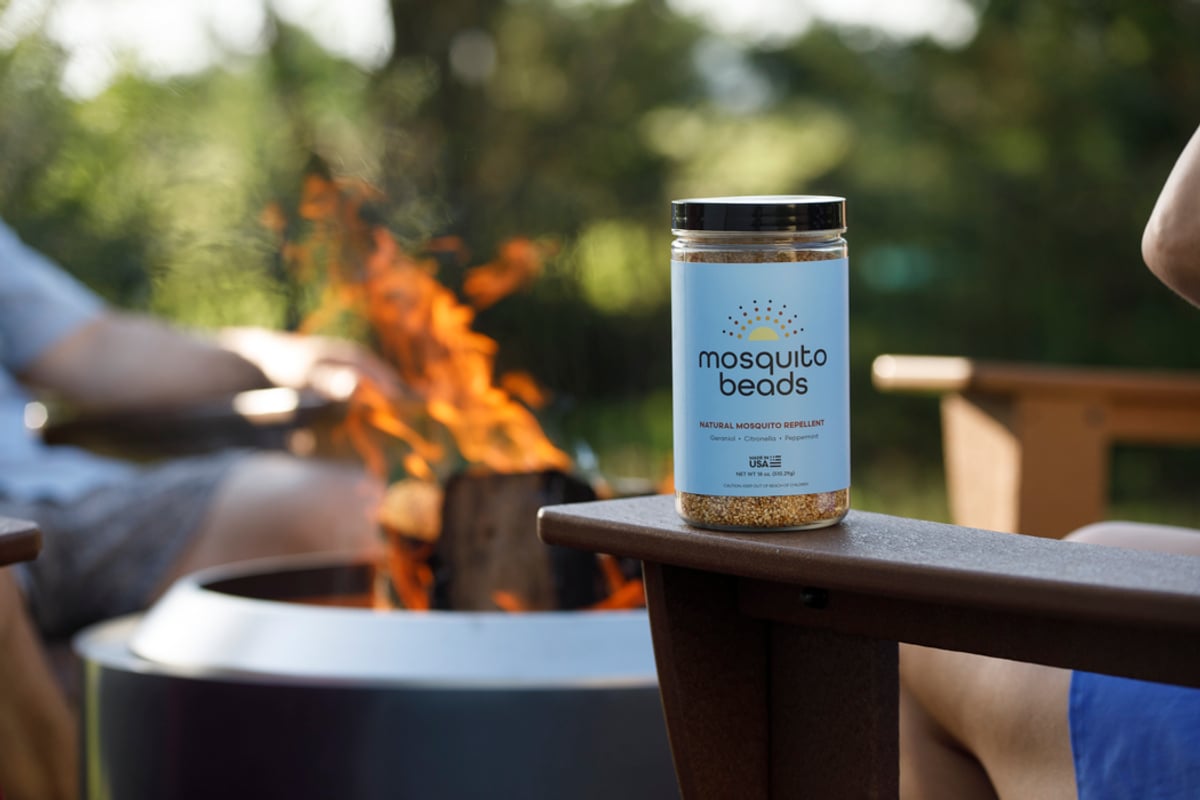
Natural Mosquito Repellent delivers these benefits through biodegradable beads infused with six proven essential oils: geraniol, citronella, peppermint, eugenol, cornmint, and rosemary. Pour them on the ground where you gather, and they mask the human scent mosquitoes track at ground level. Nothing touches skin. No smoke, no flame, no sticky spray. Just natural scent masking that protects your space for days one and two after application.
Historical Context and Modern Applications
The idea of using vanilla for mosquitoes isn't new. Historical reviews of mosquito repellent research from the 1940s document early observations about vanillin and related aromatic compounds. Researchers during World War II tested hundreds of substances seeking effective protection for troops in tropical theaters. They noted that certain aromatic compounds showed fixative properties, extending the active life of primary repellent ingredients.
These early findings laid groundwork for modern formulation science. Today's commercial developers understand vanillin's molecular structure and how it interacts with volatile organic compounds in essential oils. They design controlled-release systems, microencapsulation technologies, and carrier matrices that optimize vanillin's fixative effect while delivering active repellent compounds over extended periods.
The gap between historical vanilla-based folk remedies and modern science-backed formulations illustrates why simple DIY vanilla for mosquitoes recipes consistently underperform. You can't replicate industrial formulation chemistry in a kitchen, and you shouldn't expect homemade vanilla mixtures to compete with purpose-engineered solutions.
What Works for Real-World Outdoor Living
Successful mosquito management for suburban outdoor spaces requires understanding the difference between individual protection and spatial protection. Skin-applied repellents, whether synthetic or natural, whether enhanced with vanillin or not, protect only the person wearing them. They create personal defense bubbles that move with individuals but leave the space itself unprotected.
Spatial protection strategies recognize that outdoor rooms function like interior rooms. You don't spray everyone who enters your living room with air freshener. You don't ask dinner guests to apply aerosol treatments before sitting at your table. You control the environment itself, making the space comfortable for everyone who uses it.
Natural mosquito control for backyards based on ground-level scent masking aligns with how homeowners actually use outdoor spaces. You prepare the environment before guests arrive, the same way you arrange furniture, light candles, and set the table. Protection becomes part of space preparation rather than an ongoing personal maintenance task.

Evaluating Natural Repellent Claims
The natural products marketplace overflows with mosquito repellent claims, many built around familiar kitchen ingredients including vanilla for mosquitoes. Critical evaluation requires asking specific questions about each product:
-
What is the active mechanism? Does the product block mosquito receptors, mask scent, create physical barriers, or just smell pleasant to humans?
-
What does peer-reviewed research show? Are there published studies measuring actual protection time under field conditions, or just laboratory curiosity tests?
-
How is it applied? Does it require skin contact, aerosol distribution, burning, or ground placement? Each method creates different user experiences and protection patterns.
-
What is the protection radius? Does it shield one person, a three-foot bubble, or a defined spatial area? Can you scale coverage to match real outdoor room dimensions?
-
How long does protection last? Minutes, hours, or days? What environmental factors (wind, rain, temperature) affect duration?
-
What is the reapplication burden? Do you need to retreat every hour, every evening, or every few days? Does reapplication require interrupting activities?
Apply these questions to vanilla extract and the limitations become obvious. The active mechanism is minimal fragrance masking with rapid evaporation. Research shows vanillin works as a fixative for other compounds, not a standalone repellent. Application requires skin contact or aerosol spraying. Protection radius extends only inches from application points. Duration measures in minutes to an hour at best. Reapplication burden is high, requiring multiple treatments per evening.
The Role of Essential Oil Synergies
Modern natural repellent formulations don't rely on single ingredients. They combine multiple essential oils selected for complementary properties. Geraniol disrupts mosquito olfactory pathways. Citronella creates masking scent confusion. Peppermint and cornmint add volatile compounds that mosquitoes avoid. Eugenol provides additional sensory interference. Rosemary contributes both repellent and fixative properties.
These six-oil blends deliver substantially better performance than any single ingredient including vanilla for mosquitoes. The synergistic effect creates overlapping protection mechanisms that are harder for mosquitoes to navigate around. When delivered at ground level through biodegradable carriers, these blends create scent confusion zones that last through multiple mosquito activity cycles.
This multi-oil approach also addresses mosquito species variation. Different mosquito species show varying sensitivity to specific compounds. A six-oil blend ensures broader spectrum effectiveness across the Aedes, Culex, and Anopheles species common in North American suburban environments.
Making Informed Choices for Your Outdoor Space
Your patio represents significant investment in both money and vision. You've chosen furniture that balances comfort with weather resistance. You've installed lighting that creates ambiance without harshness. You've selected planters, cushions, and accessories that reflect your aesthetic preferences. Mosquito control should meet the same standards: effective, unobtrusive, and aligned with your priorities.
Vanilla for mosquitoes in its common forms (extract, beans, DIY sprays) doesn't meet those standards for most outdoor sanctuary hosts. The protection is too limited, the application too burdensome, and the results too inconsistent. Understanding vanillin's actual role as a fixative rather than a primary repellent helps you make better-informed decisions about what will actually protect your outdoor space.
The families who get the most use from their outdoor investments choose solutions that match how they actually live. They want protection that works during the hours they gather outside (evening dinners, sunset cocktails, late-night conversations). They want systems that scale to their actual patio dimensions, not just three-foot personal bubbles. They want natural ingredients without sacrificing effectiveness. And they absolutely want to avoid the sticky-spray experience that DEET and traditional aerosols create.
Ground-based essential oil delivery meets these requirements in ways that vanilla extract and vanilla-enhanced skin sprays cannot. You control your space rather than managing individual protection. You avoid chemical contact with skin entirely. You eliminate reapplication during events. You maintain your carefully designed aesthetic without smoke, flames, or mechanical devices. And you use biodegradable, pet-friendly ingredients that align with family health priorities.
Beyond Individual Protection to Spatial Comfort
The shift from individual to spatial protection represents more than a tactical change. It reflects a different philosophy about outdoor living. When you treat your patio as a room rather than just a surface, you think about environmental control the same way you do indoors. You don't solve temperature problems by having everyone wear coats. You adjust the thermostat. You don't address lighting by giving everyone flashlights. You install fixtures. You don't manage mosquitoes by spraying each person. You protect the space.
This spatial approach particularly matters when hosting. You can't reasonably ask dinner guests to apply repellent when they arrive. You can't interrupt conversation every hour to remind everyone to reapply. You can't expect children to maintain their own protection or monitor pets for chemical exposure. You need systems that work automatically once deployed, creating comfort for everyone who uses the space.
Solutions designed specifically for outdoor spaces recognize these hosting realities. They provide set-and-forget protection that lasts through events without intervention. They scale coverage to match actual outdoor room sizes, typically 300 to 1,000 square feet depending on product size. They work whether you're sitting quietly or moving around actively, because the protection resides in the environment rather than on individuals.
For the suburban homeowner who has tried citronella candles (too weak, too smoky) and DEET sprays (too chemical, too sticky) and wants neither, ground-based essential oil systems offer the third option that actually delivers. Natural ingredients. Effective coverage. No skin contact. No visual clutter. No ongoing maintenance during the hours you're actually using the space.
Vanilla for mosquitoes carries appeal as a natural, familiar ingredient, but the science shows vanillin works best as a fixative enhancing other repellent compounds rather than as a standalone solution. For homeowners who want to actually enjoy their outdoor spaces without sticky sprays, chemical concerns, or constant reapplication, ground-based scent masking provides a better answer. Mosquito Beads deliver six essential oils through biodegradable beads you pour where you gather, masking human scent at ground level so mosquitoes drift past instead of landing. Nothing on your skin, nothing to spray, just natural protection for your entire outdoor sanctuary.